

Maven Resource Blog
7 Roof Damage Types Homeowners Insurance Usually Covers
Roof damage coverage depends on the cause, not the age. Learn what homeowners insurance covers, how claims are paid, and what to document before you file.
Book a free roof inspection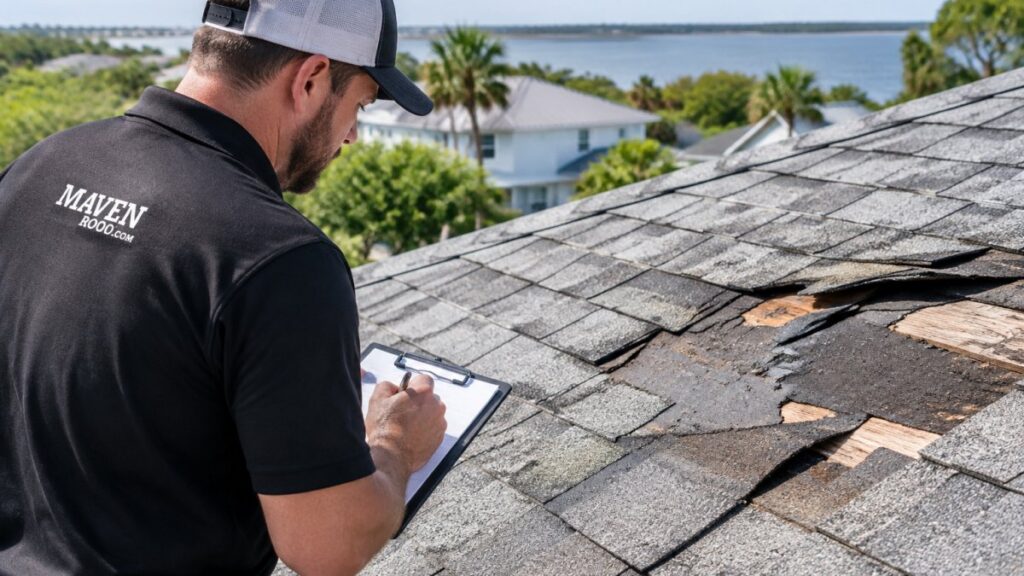
Last Updated: November 17, 2026
Quick Summary
Roof damage coverage pays to fix or replace your roof when a listed event, called a covered peril, causes the harm. Standard policies typically cover wind, hail, fire, lightning, falling trees, vandalism and sudden water damage, but exclude wear and tear. The policy responds to the event, not the roof’s age.
- A covered peril can still pay on a 20-year-old roof, though many policies then settle at actual cash value.
- On a replacement cost policy, the first check is often issued at actual cash value and withheld depreciation is released after you submit the final invoice.
- Photograph all damage before any permanent repair, since permanent work can erase the evidence your claim depends on.
- Storm damage tends to be directional and dated, while wear is uniform and gradual across all slopes.
- A percentage wind or hail deductible can quietly turn an approved claim into a small check.
Table of Contents
- What Roof Damage Coverage Actually Hinges On
- Does Homeowners Insurance Cover Roof Leaks From Rain?
- 7 Covered Perils: Wind, Hail, Fire, and More
- Will Insurance Cover a 20-Year-Old Roof?
- How to Get Insurance to Pay for Roof Replacement
- Roof Insurance Claim Documentation: What to Gather First
- Book a Free Roof Inspection Before You File
- Frequently Asked Questions
What Roof Damage Coverage Actually Hinges On
Most homeowners assume their policy covers the roof no matter what. It usually doesn’t work that way.
Roof damage coverage is the part of a home insurance policy that pays to fix or replace your roof when a listed event, called a covered peril, causes the harm.
That single idea explains most claim approvals and most denials. Below, we’ll show you exactly what gets paid, what doesn’t, and how to document your case before you file.
Sudden and Accidental Damage vs. Wear and Tear
Insurance is built for the sudden and accidental. A pine limb punches through your shingles during a thunderstorm, and the damage is sudden, accidental, and easy to date.
Wear and tear is different. Shingles curl, granules wash away, and sealant strips fail over many years. That slow decline is a maintenance issue, and a standard home insurance policy excludes it.
Does Homeowners Insurance Cover Roof Leaks From Rain?
Yes, if the rain got in because of a covered event. No, if the leak traces back to a worn roof that should have been maintained.
So does homeowners insurance cover roof leaks from rain? The answer depends on what let the water in:
- Wind lifts or tears shingles, then rain enters – typically covered.
- Hail cracks the mat, then water seeps through – typically covered.
- A falling tree opens the deck, then rain soaks the attic – typically covered.
- An aging roof leaks at a worn flashing point – typically not covered.
The water damage inside the home often follows the same rule as the roof. If the source event is covered, the interior damage usually is too. If the source is neglect, both the roof and the water damage can be denied.
7 Covered Perils: Wind, Hail, Fire, and More
Standard policies list the events they pay for. These seven show up on most home insurance policies in coastal North Carolina and across the country:
- Windstorm and wind damage – lifted shingles, torn ridge caps, missing panels.
- Hail damage – bruised shingles, cracked mats, dented metal.
- Fire damage – burned decking, melted underlayment, smoke-stained framing.
- Lightning – strike damage, often followed by a fire.
- Falling trees and limbs – impact damage to the roof surface and structure.
- Vandalism – deliberate damage to shingles, vents, or flashing.
- Sudden water damage – a burst pipe or appliance failure that soaks ceilings and attic framing.
The list is not universal. Some policies name these perils specifically. Others use an open-peril format that covers everything except what the exclusions section removes. Read your own declarations page before you assume.
North Carolina Department of Insurance consumer guides explain how policy forms differ and what homeowners should check.
Here are the seven perils most standard policies list, along with the damage each one typically causes.
| Covered peril | Typical roof damage |
|---|---|
| Windstorm and wind damage | Lifted shingles, torn ridge caps, missing panels |
| Hail damage | Bruised shingles, cracked mats, dented metal |
| Fire damage | Burned decking, melted underlayment, smoke-stained framing |
| Lightning | Strike damage, often followed by a fire |
| Falling trees and limbs | Impact damage to roof surface and structure |
| Vandalism | Deliberate damage to shingles, vents, or flashing |
| Sudden water damage | Burst pipe or appliance failure soaking ceilings and attic framing |
Will Insurance Cover a 20-Year-Old Roof?
Sometimes. Age alone does not decide it, but age changes how the claim gets paid and whether your carrier will renew the policy at all.
Here is the honest answer for older roofs:
- A covered peril still counts. If hail damages a 20-year-old roof, the policy can respond.
- Payment shifts to actual cash value. Many policies pay replacement cost on newer roofs but actual cash value on older ones. That means depreciation comes out of your check.
- Insurers inspect before renewing. Carriers increasingly send an inspector before renewal, and a worn roof can lead to a non-renewal notice.
If your roof is aging and your carrier is asking questions, a documented roof condition report can help. Our article on insurance requirements for older roofs covers the specifics homeowners run into.
How to Get Insurance to Pay for Roof Replacement
Start with proof that a covered event caused the damage. Everything else in the claim follows from that. But the step most homeowners skip is understanding how the money actually moves, because a claim can be approved and still leave you writing a check you did not expect.
Here is the practical path to a paid replacement claim:
- Get a professional inspection that separates storm damage from normal wear.
- Photograph everything before any temporary repair.
- Call your insurer and open the claim promptly.
- Meet the adjuster with your contractor present if possible.
- Review the adjuster’s estimate line by line against the scope of work.
- Negotiate the difference with documentation, not opinion.
- Complete the work and submit the final invoice for any recoverable depreciation.
How the Payout Is Actually Calculated
Two policy terms decide what lands in your hand: your deductible and whether the roof is settled at actual cash value or replacement cost.
- Deductible. This is your out-of-pocket share before the policy pays anything. It applies per claim, and on wind or hail claims some policies carry a separate percentage deductible instead of a flat dollar amount.
- Actual cash value (ACV). The insurer pays replacement cost minus depreciation for the roof’s age and condition.
- Replacement cost value (RCV). The insurer pays what it costs to replace the roof today, without subtracting depreciation, but usually only after the work is done.
A simple hypothetical shows the mechanism. Suppose a covered wind claim produces a replacement cost estimate of $18,000, the roof has $5,000 in depreciation, and the homeowner carries a $2,500 flat deductible.
Watch out: a percentage wind or hail deductible can quietly turn an approved claim into a small check, so confirm which deductible type applies to your policy before you assume the flat amount on the declarations page is the one that counts.
Matching, Code, and Material Upgrades
Two more line items can affect whether the settlement covers the full job: matching rules and ordinance or law coverage. Neither is automatic on every policy, so read the coverage forms before the adjuster visit.
If the claim comes back denied or short, you are not out of options. Our step-by-step guide on how to appeal a denied roof insurance claim walks through the reconsideration process. For the full claim workflow, see handling the roof insurance claims process.
Roof Insurance Claim Documentation: What to Gather First
Good roof insurance claim documentation is the difference between a smooth settlement and a fight. Gather it before the adjuster arrives, not after.

Build a digital folder with these items:
- Wide photos of all four roof slopes from the ground
- Close-ups of damaged shingles with a tape measure or coin for scale
- Photos of dents on gutters, vents, and metal flashing
Keep a written log of every call with your insurer: date, time, who you spoke with, and what they said. Proof of loss forms often require this detail.
Distinguishing Storm Damage From Pre-Existing Wear
This is the single most useful thing your documentation can do, because it is the line the adjuster is drawing. Storm damage tends to be directional and dated: impact marks clustered on the slopes facing the storm, fresh bruises on shingles and soft metals, granules in the gutters, and a clear before-and-after timeline.
A few evidence points carry weight with adjusters:
- Hail bruising on shingles and on soft metals like vents and gutter aprons, which shows impact rather than age.
- Wind creasing where shingles were lifted and folded back, often visible along ridges and rake edges.
- Test squares, a contractor removing a small section to show the mat and decking condition underneath, which separates fresh damage from long-term deterioration.
Watch out: making permanent repairs before the adjuster sees the damage can erase the evidence your claim depends on, so limit yourself to protective measures and photograph the original condition first.
Temporary Repairs and Contractor Coordination
Your policy generally expects you to prevent further damage after a covered loss, and most policies will consider reasonable costs for that, but the key word is reasonable, and the receipts matter (Settling insurance claims after a disaster).
Coordinate your contractor’s estimate with the claim rather than around it. Our guide on talking to an insurance adjuster after storm damage covers how to keep that conversation productive.
When the Estimate Comes Back Low or Denied
A low estimate is not the final word. Review the adjuster’s report line by line against your contractor’s scope, request clarification in writing on any line item you believe is wrong, and submit additional documentation, test-square photos, code citations, and material specifications, to support a revision. If the disagreement persists, ask your insurer about the appraisal process named in your policy, and know that your state insurance department accepts consumer complaints.
Book a Free Roof Inspection Before You File
The single best move before any claim is a documented inspection by a roofing professional.
At Maven Roofing, we provide free roof inspections across Eastern North Carolina, from Wilmington and Jacksonville to New Bern, Goldsboro, and Greenville.
If you’re about to invite someone onto your roof, know the warning signs first. Our guide on how to spot a free roof inspection scam covers what to watch for in 2026.
A few things we look at during the inspection:
- Shingle condition across every slope, not just the front
- Granule loss and mat exposure
- Flashing and sealant at penetrations
We’re veteran-owned, GAF Master Elite certified, and we’ve served Eastern NC since 2015.
If a storm just came through, don’t wait for the next rain to find out whether your roof held.
Frequently Asked Questions
What types of roof damage may homeowners insurance cover?
Most standard policies cover damage from named perils such as wind, hail, fire, lightning, falling trees, and vandalism. The key distinction is cause: a sudden event that damages the roof is typically covered, while gradual deterioration from age, neglect, or lack of maintenance usually is not. Roof damage coverage also depends on your policy form, deductible, and whether the damage exceeds your deductible. Read your declarations page and exclusions before filing so you know what your specific policy lists.
Does homeowners insurance cover roof leaks caused by rain?
It depends on why the roof leaked. If a windstorm lifted shingles and rain got in, that is usually a covered peril and the resulting water damage may be covered too. If the leak came from a roof that simply wore out, most policies exclude it as lack of maintenance. Document the cause with photos of lifted, missing, or impact-damaged shingles, not just the ceiling stain, because the adjuster needs to connect the water to a covered event.
Will insurance cover a roof that is 20 years old?
Age alone does not disqualify a roof. What matters is the cause of the damage and your policy terms. A 20-year-old roof hit by hail can still support a claim, but the payout may be reduced by depreciation if you carry actual cash value rather than replacement cost coverage. Some carriers also apply age-based surcharges or require an inspection before renewal. Ask your agent how your policy treats an aging roof before storm season.
What should I document before a roof insurance adjuster visits?
Photograph every elevation of the roof and any interior stains, then note the date of the storm and any temporary repairs you made. Keep receipts for tarps, materials, and contractor labor. Save your policy declarations page, a written repair estimate, and a simple timeline of events. Roof insurance claim documentation that ties a specific date and cause to visible damage gives the adjuster less room to classify the loss as wear and tear.
