

Maven Resource Blog
Is a Full Roof Replacement Worth the Investment?
Explore whether a full roof replacement is worth the cost. Compare repair vs. replacement, ROI, and home value impact to make an informed decision.
Book a free roof inspection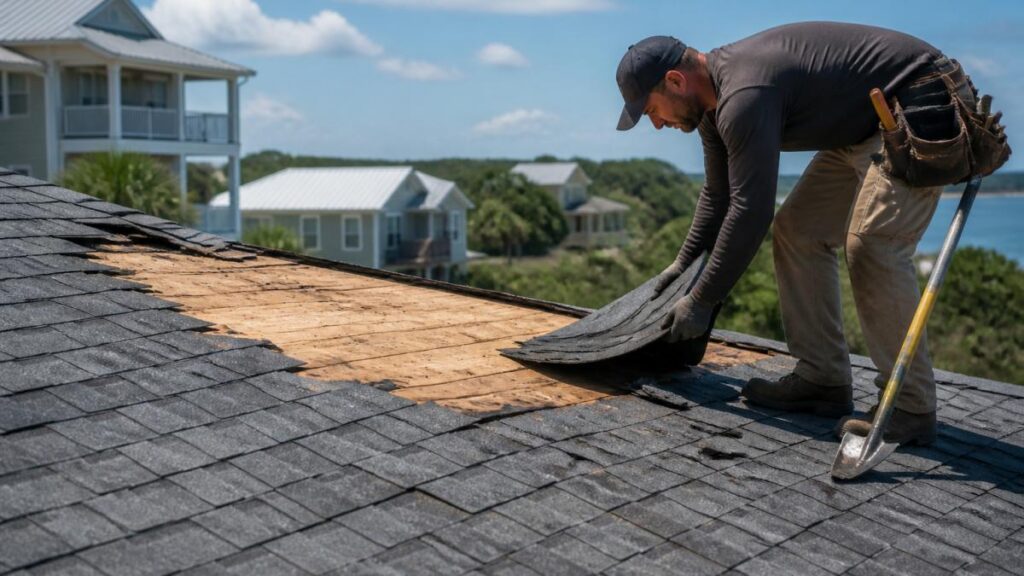
Table of Contents
- Is a Full Roof Replacement Worth the Investment?
- Roof Repair vs. Replacement: When to Choose Each
- Signs You Need a New Roof
- How Long Does a Roof Last?
- Roof Replacement Return on Investment
- Factors That Affect Roof Replacement Value
- Making Your Decision: A Replacement Checklist
- Frequently Asked Questions
Last Updated: October 6, 2026
Is a Full Roof Replacement Worth the Investment?
Whether a roof replacement worth the investment is one of the largest home improvement decisions a homeowner will face. The upfront cost is significant, but so are the long-term benefits: weather protection, lower maintenance, and increased home value.
At Maven Roofing, we help homeowners in Eastern North Carolina navigate this decision every day. Coastal properties face salt spray, hurricane-force winds, and relentless moisture that age roofs faster than elsewhere.
Roof Repair vs. Replacement: When to Choose Each
The choice comes down to cost, frequency, and remaining roof lifespan. A single leak or missing shingles calls for repair.
The practical dividing line: if your roof is under 15 years old and damage is isolated to one area, repair is usually right.
Past the 20-year mark, the math shifts. Shingles lose flexibility and durability, so a repair might hold a season or two while underlying deterioration continues, you’re paying for temporary fixes while delaying replacement.
The coastal environment accelerates this timeline.
| Condition | Best Choice | Why |
|---|---|---|
| Single damaged area, roof under 15 years | Repair | Remaining lifespan justifies targeted fix |
| Multiple damage zones, roof 15-20 years | Evaluate both | Cost of repairs approaching replacement cost |
| Roof over 20 years, widespread damage | Replacement | Repairs become recurring; replacement extends protection 20-30 years |
| Coastal property, roof over 18 years | Replacement | Salt spray and weather accelerate aging |
Signs You Need a New Roof
Age and Weather Damage
Age is the strongest predictor of replacement need.
Look for curling, cracking, or missing shingles. Granule loss, the protective coating breaking down, shows up as debris in gutters or bare spots.
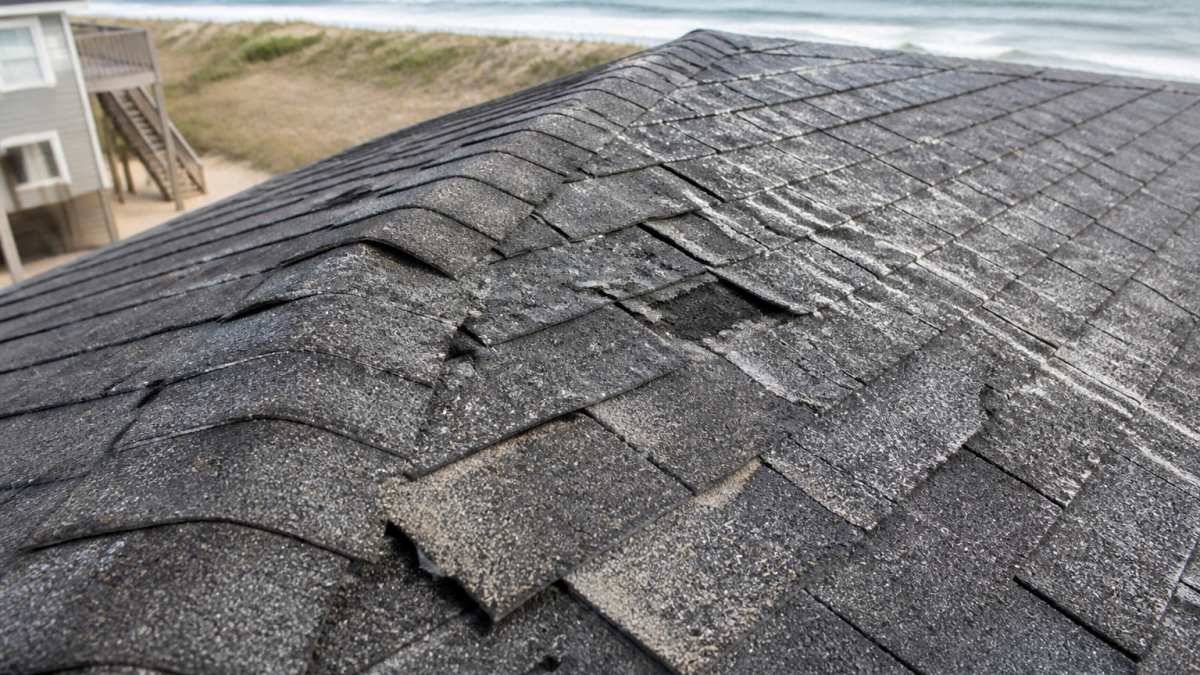
Coastal weather accelerates damage: salt spray corrodes flashing and fasteners, high winds loosen shingles and expose underlayment, and moisture rots decking.
Multiple Damaged Areas and Ongoing Repairs
Damage in multiple locations signals systemic aging rather than isolated weather events.
Ongoing repairs are the clearest financial signal. If you’ve patched the same roof twice in three years, or fixed three or more areas, replacement becomes cost-effective.
Insurers track this too. Some policies deny coverage if the roof is beyond a certain age or shows deferred maintenance. If your insurer has flagged your roof or threatened non-renewal, replacement often becomes necessary to keep coverage.
How Long Does a Roof Last?
Roof lifespan depends on materials, climate, and maintenance. Asphalt shingles last 20-25 years, metal roofing 40-50 years, wood shakes 20-40 years, and tile can exceed 50 years.
These timelines assume normal weather and regular maintenance.
Maintenance matters. Regular cleaning to remove moss, algae, and debris extends roof life, and rejuvenation treatments can add 5-10 years to a roof not yet ready for full replacement, particularly valuable on coastal properties.
Roof Replacement Return on Investment
The return on a new roof depends on how much you would have spent on repairs anyway, how you pay for the project, and what your insurer and the tax code do with it.
Step 1: Quantify the repair-versus-replacement break-even
Replacement isn’t competing against a zero-cost alternative, it’s competing against the stream of repairs you would otherwise pay for. Put both on the same timeline.
A common pattern among homeowners weighing this decision:
- Add up your last five years of roof spending. Include patching, flashing repairs, leak diagnostics, emergency tarping, and interior damage the roof caused (stained ceilings, drywall, insulation), the line most people forget, and often the largest.
- Divide by five for an average annual repair cost.
- Assume that average rises. Once shingles pass their rated life, repair frequency and severity climb each year, so a flat projection understates the cost of waiting.
- Compare the cumulative repair total over the years you plan to stay against the net cost of replacement.
The break-even point is the year those two lines cross. For a roof past its rated lifespan with two or more repairs in three years, that crossing often happens within a handful of years, which is why the “repairs exceed roughly half of replacement cost” rule of thumb circulates.
The honest framing is not “replacement pays for itself.” It is “replacement converts an unpredictable, rising repair bill into a fixed, known cost with a defined service life.” For some homeowners that trade is clearly worth it; for others, a few more years of targeted repairs is the better financial move.
Step 2: Account for how you pay for it
A recovery percentage quoted on the sticker price ignores financing. Pay cash and your return is avoided repair costs plus resale value captured; finance it and your true cost includes interest, stretching the payback period.
- Cash: simplest math, the project cost is the investment, and the return is avoided repairs plus resale value plus any insurance premium reduction.
- Home equity loan or line of credit: interest is typically lower than unsecured borrowing, but you add a monthly obligation and, with a line of credit, a variable rate.
- Contractor financing or unsecured loan: usually the highest rate, which can meaningfully extend the break-even point. Ask for the annual percentage rate, not the monthly payment.
Run the break-even twice: once paying cash, once financing. If the financed version does not cross over before you expect to sell, the financial case is weaker than the sticker-price comparison suggests.
Step 3: Check insurance and tax treatment before you sign
These two items move the real cost more than most homeowners expect.
Insurance. Read your policy before assuming a claim will cover the roof. Is it covered at replacement cost or actual cash value?
Book Your Free Roof Inspection Online →
Taxes. Roof replacement on your primary residence is generally a capital improvement, not a deductible repair, not deductible in the year you spend it, but it adds to your cost basis and can reduce capital gains when you sell.
Step 4: Separate financial payback from ownership return
Resale value is only one return, and it only matters if you sell. If you plan to stay, the return shows up differently:
- Avoided interior damage. A failing roof risks water intrusion that damages decking, insulation, ceilings, and sometimes electrical components, a real, hard-to-cap risk.
- Predictable maintenance. A new roof under warranty replaces an open-ended repair budget with a defined service life.
- Comfort and efficiency. Proper underlayment and ventilation reduce attic heat gain, easing the load on your cooling system. Treat efficiency as a secondary benefit, not the reason to replace.
What the resale number actually reflects
Your actual recovery depends on local resale conditions, the material you choose, how the new roof compares to neighboring homes, and whether buyers treat the roof as a deal-breaker or a negotiating chip. In markets where lenders and insurers scrutinize roof age, a new roof can mean the difference between a sale and a stalled listing. Get a local opinion before you bank on it.
Before you decide, get two numbers in writing: a contractor’s itemized replacement quote and your insurer’s answer on whether the current damage is claim-eligible. Those two documents turn a vague “is it worth it” question into a specific break-even calculation you can actually act on.
Factors That Affect Roof Replacement Value
Roofing Materials and Durability
Material choice dramatically affects replacement cost and long-term value. Asphalt shingles are the most affordable option and suit most homes.
Architectural shingles offer better wind resistance and durability than standard three-tab shingles at a modest cost increase, an upgrade worth considering for coastal properties.
Underlayment and fastening matter as much as visible shingles. These upgrades aren’t visible, but they directly affect how long your roof lasts and how well it protects your home during storms.
Coastal Weather Protection and Insurance Coverage
Coastal properties require specialized roofing approaches. Salt spray corrodes standard materials faster. High winds demand reinforced fastening and impact-resistant shingles. Moisture requires superior underlayment and ventilation.
Insurers recognize these needs. Policies often require impact-resistant shingles in coastal areas, and some offer premium discounts for roofs with hurricane straps or metal fasteners instead of nails.
Check your policy. If your insurer has flagged your roof or threatened non-renewal, replacement becomes mandatory to maintain coverage, the cost of losing insurance far exceeds the cost of roof replacement.
Making Your Decision: A Replacement Checklist
What actually determines whether replacement is worth it is the quality of the inspection behind the recommendation and the completeness of the bids in front of you.
Checklist 1: What a real roof inspection should cover
A useful inspection goes well beyond looking at shingles from the ground. Ask the inspector to document each of these, ideally with photos:
Surface and shingles
- Curling, cracking, buckling, or missing shingles, with locations noted
- Granule loss, check gutters and downspouts
- Hail or impact bruising, which can look minor but compromise the mat underneath
The layers you cannot see from the driveway
- Underlayment condition, intact, or dried out and torn?
- Decking and sheathing, soft spots, delamination, or rot indicate water intrusion
- Flashing at chimneys, valleys, vents, and wall intersections, the most common leak points and the most commonly skipped in a quick bid
Structure and drainage
- Fascia, soffit, and drip edge condition
- Gutter attachment and whether water is directed away from the foundation
- Sagging or uneven roof lines that suggest structural movement
A bid that does not mention underlayment, flashing, or ventilation is not a complete bid, it is a shingle price. Those hidden layers are where most premature roof failures originate, and they are the easiest line items to leave out when a contractor is competing on the lowest number.
Checklist 2: How to compare contractor bids apples-to-apples
Two quotes for “a new roof” can differ by thousands of dollars and both be honest, they may not be quoting the same scope. Normalize them before comparing:
- Tear-off vs. overlay. Does the bid include removing the old roof down to the deck, or layering new shingles over the old? Tear-off costs more but lets the crew inspect and repair the decking and is often required by code or the manufacturer’s warranty.
- Decking allowance. Is there a stated per-sheet price for rotted sheathing found during tear-off, or a vague “as needed”? Get the number in writing.
- Underlayment type. Synthetic vs. felt, and the product specified. Ask for the brand and model.
Turning the checklists into a decision
Once you have a documented inspection and two or three normalized bids, the decision usually resolves into one of three paths:
- Targeted repair. Damage is isolated, the roof is well within its service life, and the underlying layers are sound. Repair is the right call.
- Partial replacement or repair plus monitoring. A defined section is failing while the rest is serviceable. Ask about matching, new shingles may not match existing ones, and a partial replacement can create a visible seam. Also confirm whether the manufacturer’s warranty covers a partial installation, because many do not.
- Full replacement. Damage is widespread, the roof is at or past its rated life, the hidden layers are compromised, or code and insurance requirements make a partial fix impractical. This is where the break-even math does its work.
The single most useful thing you can do is get a written inspection that names the condition of the underlayment, flashing, decking, and ventilation, not just the shingles. That document is what lets you compare bids honestly and decide whether you are buying protection or just buying shingles.
Get a professional roof inspection before deciding. An experienced contractor can assess remaining lifespan, identify hidden damage, and give honest guidance on repair versus replacement. At Maven Roofing, we provide free inspections and detailed assessments to help you decide with confidence.
Frequently Asked Questions
Should you replace a 20-year-old roof?
A 20-year-old roof depends on its condition, material type, and local weather exposure. Asphalt shingles typically last 15-20 years; if your roof is reaching or past this age, have a professional inspection to assess remaining lifespan. Coastal properties in Eastern North Carolina experience accelerated wear from salt spray and humidity, so a 20-year-old roof may need replacement sooner. If damage is visible or repairs are becoming frequent, full roof replacement is often more cost-effective than ongoing repairs.
What is the 25% rule for roofing?
The 25% rule suggests that if repairs will cost more than 25% of a full roof replacement cost, replacement may be a more sensible choice. This helps homeowners consider the long-term value of their investment. For example, if replacement costs $10,000 and a repair estimate approaches $2,500 or higher, replacement can be a better long-term investment. This rule accounts for the reality that aging roofs often develop multiple problems, and patching one area doesn’t prevent future damage elsewhere.
Does a new roof increase home value?
Yes, a new roof improves home value and buyer confidence during a sale. Buyers view a new roof as protection against future problems and reduced maintenance costs. The return on investment varies by market and roof material, but a new roof typically recovers 60-80% of its cost in resale value. Beyond the financial return, a new roof provides weather protection, improves curb appeal, and may lower insurance premiums, making it valuable for both immediate ownership and future sale appeal.
How do you know whether to repair or replace a roof?
Compare the repair cost against the roof’s age and condition. If your roof is under 10 years old with isolated damage, repair is usually wise. If it’s past 15 years, showing multiple damaged areas, or requiring repeated repairs, full roof replacement prevents ongoing expenses and water damage. Get contractor estimates for both options and apply the 25% rule. Also consider your insurance coverage, coastal weather exposure, and plans to stay in the home; if you’re selling soon, replacement adds more resale value than repair.
How long does a full roof replacement last?
Roof lifespan depends on material: asphalt shingles last 15-20 years, architectural shingles 20-25 years, and metal or tile roofing 30-50+ years. Coastal properties in Eastern North Carolina may see shorter lifespans due to salt spray, humidity, and hurricane exposure. Proper maintenance, regular inspections, and professional installation extend roof life. A new roof with quality materials and expert installation provides decades of weather protection and durability, making the upfront investment worthwhile for long-term home protection.