

Maven Resource Blog
How to Choose Roofing Contractors for Coastal Homes in 2026
Compare coastal roofing contractors in Eastern NC by materials, inspection steps and repair versus replacement. Learn how to hire with confidence in 2026.
Book a free roof inspection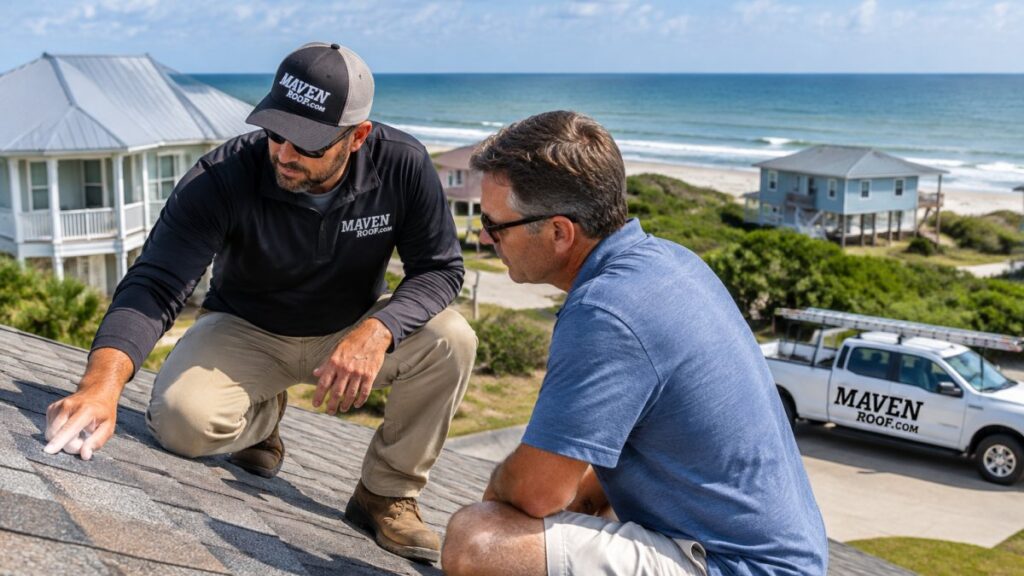
Last Updated: November 23, 2026
Quick Summary
Coastal living comes with unique roofing challenges. Is your roof prepared?
Choosing the right roofing contractor in Eastern North Carolina means prioritizing local expertise, industry certifications, and solutions built to withstand coastal conditions.
Here are five things every coastal homeowner should know:
- Salt air, wind-driven rain, and extreme heat can accelerate roof deterioration.
- Standing-seam metal roofing offers excellent wind and corrosion resistance when properly installed.
- A sealed roof deck is a key component of FORTIFIED™ roofing protection.
- Isolated roof damage doesn’t always require a full replacement.
- Documenting storm damage before temporary repairs, when safe, can help support your insurance claim.
Protect your investment by choosing a qualified contractor who understands coastal roofing and puts your home’s best interests first.
Table of Contents
- What are the best roofing contractors in Eastern North Carolina for coastal homes?
- Why Coastal Conditions Change the Hiring Decision
- The Best Roofing Material for Coastal Homes: Metal vs. Shingle
- Coastal Roof Inspection: What a Qualified Contractor Checks
- Roof Repair vs. Replacement: How to Decide on an Older Coastal Roof
- Questions to Ask a Roofing Contractor Before You Sign
- Wind Mitigation, FORTIFIED Standards, and Insurance Documentation
- Booking Your Free Coastal Roof Inspection
- Frequently Asked Questions
What are the best roofing contractors in Eastern North Carolina for coastal homes?
The best coastal roofing contractors in Eastern North Carolina combine local storm experience, manufacturer certifications, and a repair-first mindset. At Maven Roofing, a veteran-owned contractor based in Hampstead, NC, we have worked on coastal roofs since 2015. The biggest one: hiring a crew that knows inland roofs but not salt air, wind-driven rain, or the paperwork your insurer wants after a storm.
Below, we break down what actually separates a good coastal roofer from a cheap one, how to compare materials, and the exact questions to ask before you sign anything.
Why Coastal Conditions Change the Hiring Decision
A roof near the water lives a harder life than one twenty miles inland. Salt-air corrosion eats at fasteners and metal components. Wind-driven rain pushes water sideways into places gravity-fed drainage never touches.
That combination means coastal roofing contractors need to understand more than installation. They need to know how coastal climate affects underlayment, flashing, and ventilation systems over time.
Many roof leaks on coastal homes come from isolated issues such as failing pipe boots, damaged flashing, or lifted edges rather than the shingle field itself. A repair-first contractor will look for these specific failure points.
FEMA guidance on wind and water damage to coastal buildings
The Best Roofing Material for Coastal Homes: Metal vs. Shingle
The best roofing material for a coastal Eastern NC home depends on your wind zone, your budget, and how long you plan to stay. Metal roofing wins on wind and salt resistance. Asphalt and synthetic shingles win on upfront cost and repair simplicity. Neither is wrong, but they fail differently, and the failure mode matters more near the water than the marketing brochure admits.
Most coastal roofing decisions in this region come down to three families of product: standing-seam metal, architectural asphalt shingles (including impact-resistant lines), and synthetic shingles or synthetic slate. Here is how each one actually behaves when salt air, wind-driven rain, and summer heat work on it for twenty years.
How Salt Air, Wind-Driven Rain, and Heat Affect Each Material
Standing-seam metal roofing handles wind uplift and salt-air corrosion well because the panels interlock vertically and the fasteners are concealed under the seam rather than punched through the face of the panel. Because the finish coating and metal-repair experience can vary from one contractor to another, reading roofing contractor reviews can help you weigh how carefully each roofer addresses salt-air exposure and panel-level repairs.
Architectural asphalt shingles are the most common roof in Eastern NC for good reason.
Synthetic shingles and synthetic slate sit between the two on cost and offer a heavier, more premium look. They resist impact and algae well, and many lines carry strong wind ratings.
|
Feature |
Standing-Seam Metal |
Architectural Asphalt |
Synthetic Shingle / Slate |
|---|---|---|---|
|
Wind uplift resistance |
Excellent with concealed fasteners and proper clips |
Good when rated and nailed to spec |
Good to excellent depending on line |
|
Salt-air corrosion |
Strong with coastal-grade coating; fasteners concealed |
Fasteners, boots, and edge metal are the weak points |
Varies by product; check coastal ratings |
|
Upfront cost |
Higher |
Lower |
Mid to high |
|
Repair ease |
Panel-level; needs a metal-capable crew |
Section-level; easiest to repair |
Product-dependent; parts sourcing can lag |
|
Lifespan |
Long |
Moderate |
Long |
|
Best fit |
Long-hold coastal homes, high-wind exposure |
Budget-conscious replacements, mixed-age neighborhoods |
Homeowners wanting premium look with strong wind ratings |
On coastal roofs, the details around the material, such as pipe boots, edge metal, and flashing, often determine how long the roof lasts.
For a deeper side-by-side, read metal vs. asphalt shingles for NC homes.
Coastal Roof Inspection: What a Qualified Contractor Checks
A proper coastal roof inspection covers more than a glance from the driveway. It looks at the moisture barrier, flashing details, ventilation systems, and every penetration where water can get in.
Here is what a thorough coastal roof inspection should cover:
- Pipe boots and seals around every penetration
- Flashing at chimneys, walls, and valleys
- Ridge and edge condition for wind uplift
- Attic ventilation and signs of trapped moisture
- Granule loss and shingle condition, not just age
- Fastener condition on metal panels
Roof age and roof condition are two very different things. A twenty-year-old roof with sound flashing and good ventilation can outlast a ten-year-old roof installed poorly.
Roof Repair vs. Replacement: How to Decide on an Older Coastal Roof
Repair is usually the right call when damage is isolated: a few missing shingles, a failed pipe boot, or damaged flashing. Replacement makes sense when the decking, underlayment, or overall system has reached the end of its service life.
Maven Roofing takes a repair-first approach: where a roof can be fixed, we aim to fix it. Targeted repairs can extend a roof’s useful life. If your roof is showing its age but is not failing, roof rejuvenation may also be an option worth comparing against both.
A thorough assessment should include the attic and the roof before a replacement is recommended.
NREL research on cool roofs and coastal energy performance
Questions to Ask a Roofing Contractor Before You Sign
Ask every contractor the same questions and compare the answers side by side. The right questions to ask a roofing contractor reveal whether you are talking to a professional or a salesperson.
- Are you licensed and insured, and can I see proof?
- What manufacturer certifications do you hold?
- Will you put the scope of work and cost breakdown in writing?
- Who handles communication after I sign, and who do I call?
- What does your workmanship warranty actually cover?
- Will you document storm damage for my insurance claim?
For a full framework, see how to choose a roofing contractor step by step, and for credentials to verify locally, read hiring certified roofers in Eastern NC.
Wind Mitigation, FORTIFIED Standards, and Insurance Documentation
The features that keep a roof attached in high wind are also the features insurers and underwriters care about, and documenting them is its own skill.
What Wind Mitigation Actually Means on a Coastal Roof
Wind mitigation is a set of construction details that resist uplift, the suction force that tries to peel a roof off during a hurricane or strong nor’easter. On an Eastern NC home, the details that matter most are:
- A sealed roof deck. A secondary water barrier (often a peel-and-stick membrane over the deck) keeps wind-driven rain out even if shingles lift. This is the single most important FORTIFIED detail for coastal homes.
- Enhanced fastening. Ring-shank nails at the manufacturer’s specified interval and pattern, rather than the minimum code staple or smooth nail.
- Reinforced edges and ridge. Edge metal and ridge caps fastened to resist uplift at the most vulnerable points of the roof.
- Properly attached underlayment and flashing. The layers beneath the shingles are what actually keep water out when the surface fails.
A FORTIFIED Roof designation is a third-party program that requires these details together, and it should be verified rather than self-applied.
How Wind Mitigation Connects to NC Insurance
Insurance treatment of wind mitigation varies by carrier, county, and policy, so homeowners should ask their insurer which documentation it accepts. Maven Roofing can help document roof features that are relevant to an insurance conversation.
Documentation of roof features can be useful for an insurer or adjuster, and homeowners should ask their contractor what records are available.
The NC Storm Claim Process, Step by Step
After a hurricane or severe storm, preparation helps the claim process. Here is a general sequence homeowners can follow:
- Document before you touch anything. Photograph and video the damage, shingles, flashing, ceilings, attic, before any temporary repair. Adjusters want to see the loss as it happened.
- Make safe, temporary repairs only. Stop active water intrusion with tarps or temporary sealing. Keep every receipt; homeowners should check with their insurer whether temporary protection is covered.
- File the claim and request an adjuster inspection. Report the loss promptly and get the inspection on the calendar.
- Have your contractor meet the adjuster on site. A contractor who can walk the roof with the adjuster, point to specific damage, and explain the repair scope in insurance terms keeps small items from being missed.
- Keep the paper trail. Photos, receipts, the contractor’s written scope, and the adjuster’s report all belong in one folder.
Damage that is only visible up close, such as lifted edge metal, cracked pipe boots, or compromised flashing, can be missed from the ground. Having a contractor present on the roof during the adjuster’s inspection can help document it.
Insurance Institute for Business & Home Safety FORTIFIED program
If you are not sure whether your current roof has any wind mitigation features at all, that is exactly what a free roof inspection is for, we can review what is there and what may be missing.
Booking Your Free Coastal Roof Inspection
If you are weighing repair, rejuvenation, or replacement on a coastal home anywhere from Hampstead to Wilmington, the next step is a real inspection, not a sales pitch. Maven Roofing offers free roof inspections with straightforward, no-pressure recommendations.
If you want to understand how salt air and storms affect your whole property, our guide to preventing water damage in coastal homes is a good companion read.
Coastal roofs fail in specific, predictable ways, and the contractor you hire should be able to name them before you point them out. Maven Roofing brings veteran-owned discipline, coastal weather expertise, and a repair-first approach to every home we inspect.
Frequently Asked Questions
How can I tell if a roofing contractor is qualified for coastal homes?
Look for a licensed and insured contractor with manufacturer credentials such as GAF Master Elite, plus verifiable warranty terms in writing. Ask how they handle wind-driven rain, flashing, and underlayment details specific to salt-air environments, and request local references. A qualified coastal roofing contractor will also document damage for insurance and explain ventilation and wind mitigation rather than quoting a replacement on the spot. Confirm the crew is employed or vetted, not subcontracted without oversight.
How often should a coastal roof be inspected?
Schedule a coastal roof inspection once a year and after any named storm or hail event. Salt air, wind-driven rain, and intense sun age roofing materials faster near the coast, and small flashing or pipe boot failures are easier to repair before they rot decking. Homeowners in coastal communities may also find a roof inspection useful when reviewing insurance coverage. Maven Roofing offers free roof inspections.
What is the best roofing material for coastal homes?
Standing-seam metal offers strong high-wind resistance, making it a common choice for coastal homes. Asphalt shingles from a quality manufacturer remain the most affordable option and perform well when installed with proper underlayment and flashing. Synthetic shingles such as F-Wave bridge the gap with impact resistance and a shingle look. The right choice depends on your roof pitch, budget, and insurance requirements, so compare wind ratings and warranty coverage before deciding.
How do I know whether my coastal roof needs repair or replacement?
Age alone does not decide it. Roof age and roof condition are different things. A roof with isolated missing shingles, a failed pipe boot, or damaged flashing often holds up well after a targeted repair. Widespread granule loss, sagging, or repeated leaks in multiple areas point toward replacement. Maven Roofing takes a repair-first approach and will tell you when a repair or roof rejuvenation can extend the life of the roof you already have instead of pushing a full replacement.
