

Maven Resource Blog
How to Get FORTIFIED Roof Certification, Step by Step
Learn how to earn fortified roof certification in Eastern NC: eligibility checks, the inspection process, and how to request your certificate.
Book a free roof inspection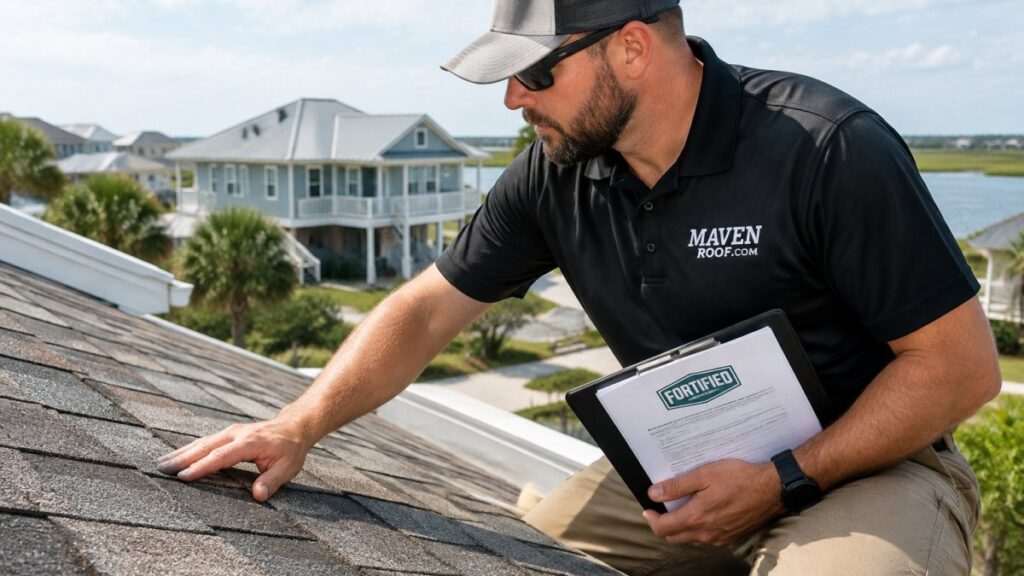
Last Updated: November 11, 2026
Quick Summary
To get fortified roof certification for a home, first confirm you need the homeowner path, then have a roofer review the roof and make needed repairs. Next, request an evaluation from an independent evaluator, who checks the installed roof against the FORTIFIED standard and issues a certificate if it passes.
- Confirm whether you need a homeowner roof designation or contractor certification before starting.
- Have a qualified roofer review the roof and note covering type, age, and problem areas first.
- Fix leaks, loose shingles, and damaged flashing before the evaluator visits.
- Designations are issued by independent evaluators, not by the contractor doing the work.
- Incomplete paperwork that doesn’t match the deed is the leading cause of stalled certificate requests.
Table of Contents
- Start Here: Which FORTIFIED Designation You Need
- FORTIFIED Roof Certification Requirements to Check First
- Step-by-Step: The FORTIFIED Roof Evaluation Process
- Documentation and Inspection Checklist for Your Home
- How to Make a FORTIFIED Roof Certificate Request
- Working With a FORTIFIED Certified Service Provider
- Booking Your Free Roof Inspection to Start Your FORTIFIED Roof Review
- Frequently Asked Questions
Start Here: Which FORTIFIED Designation You Need
Before you start, confirm which FORTIFIED program you actually mean. The name covers two different paths. One certifies a contractor to do FORTIFIED work. The other gives a home a FORTIFIED roof designation. Many homeowners search for the second and find pages written for the first. Knowing which one applies saves you time.
Maven Roofing can help you find the right starting point. A free roof inspection is a good first step if you are unsure, and we can walk you through what a fortified roof certification requires for your home in Eastern North Carolina. Once you know what your home needs for certification, comparing those steps with hurricane proof roofing considerations can help you plan for the storm protection that suits your region.
If you are a homeowner, you want a roof designation for your home. This means an evaluator checks your roof against FORTIFIED standards and, if it passes, issues a certificate you can share with your insurer or a future buyer. To see how a FORTIFIED roof can affect resale value, read our guide.
If you are a roofing professional, you want to certify as a service provider. This means your business completes prequalification, training, and an exam so it can perform FORTIFIED work.
Most of this guide focuses on the homeowner path, since that is the question most property owners bring to us. Keep the contractor path in mind if you run a roofing business.
FORTIFIED Roof Certification Requirements to Check First
Before you request anything, check a few basics. These checks prevent most delays.
- Confirm your roof type. FORTIFIED standards apply to specific roof systems. Ask your contractor or evaluator whether your current roof qualifies.
- Check your roof’s age and condition. A roof with active leaks, missing shingles, or damaged flashing may need repair first.
- Find out who will evaluate it. Designations are issued through independent evaluators, not by the contractor doing the work (FORTIFIED Home – Homepage – FORTIFIED).
- Ask what documentation you need. Requirements vary by case, so get the list in writing before scheduling.
Watch out: Do not assume a standard roof repair automatically qualifies your home. The evaluator checks the installed system against the standard, and a fresh shingle job can still fall short on fastening or flashing details.
Step-by-Step: The FORTIFIED Roof Evaluation Process
The evaluation follows a sequence, and the order matters because each stage depends on the one before it. Here is what happens at each stage and what you can do to keep the visit productive.
-
Start with a roof condition review. Before you contact an evaluator, have a qualified roofer look at the roof and tell you plainly whether it is ready. Ask them to note the roof covering type, the approximate age, the number of layers, and any areas showing lifted shingles, cracked sealant, or deteriorated flashing around vents, chimneys, and valleys. This review tells you whether the evaluation is worth scheduling now or whether repairs come first.
-
Make needed repairs first. Fix active leaks, loose or missing shingles, and damaged flashing before the evaluator arrives. An evaluator cannot assess a roof fairly while it is actively failing in visible places, and a repair made before the visit is usually less expensive than a second visit and a re-scheduled review. Keep receipts and written descriptions of every repair, since the evaluator may ask what was changed and when.
-
Request an evaluation. Contact an independent evaluator affiliated with the FORTIFIED program and schedule the visit. Ask which components they will assess, whether they need access to the attic, and what paperwork they expect you to have on hand. Ask the evaluator about their fee and timeline for a written result before you book.
-
Let the evaluator inspect the roof. The evaluator checks the installed system against the FORTIFIED standard. In practice this means looking at how the roof covering is fastened, the condition and spacing of nailing, the sealing at roof edges and eaves, the flashing details at penetrations, and the attachment of the roof deck. Many evaluators also inspect from the attic to confirm deck attachment and ventilation. You can help by making the roof and attic accessible and by pointing out any repairs you have completed.
-
Address any gaps. If the roof falls short, the evaluator will list the specific items to correct. Ask for that list in writing, with each deficiency tied to the part of the standard it does not meet. Corrections are typically verified in a follow-up inspection, so plan for that visit rather than assuming a single pass will close everything out.
-
Receive your result and certificate. Once the roof meets the standard, the designation certificate can be requested through the program channel your evaluator specifies. Save the certificate with your home records and share a copy with your insurer, since insurers that recognize the designation will ask for it when reviewing a policy.
Watch out: The most common delay is scheduling the evaluation before the repairs are finished. That almost always means a second visit, another round of scheduling, and additional cost. Another frequent problem is attic access: if the evaluator cannot inspect the deck attachment from below, the review can stall until someone clears the space.
Watch out: Do not assume a passing result on a neighbor’s home applies to yours. Each roof is evaluated on its own installed components, including the fastening, flashing, and edge details specific to that structure.
The evaluation follows a fixed sequence, and each stage depends on the one before it. The table below summarises the steps.
| Step | What to do | Key note |
|---|---|---|
| 1. Roof condition review | Have a qualified roofer check the roof before contacting an evaluator | Note covering type, age, layers and problem areas |
| 2. Make repairs | Fix leaks, loose or missing shingles, and damaged flashing | Keep receipts and written repair descriptions |
| 3. Request evaluation | Contact an independent FORTIFIED evaluator and schedule the visit | Ask about fee and timeline for a written result |
| 4. Inspection | Evaluator checks fastening, edges, flashing and deck attachment | Make roof and attic accessible |
| 5. Address gaps | Correct each listed deficiency | Corrections are verified in a follow-up inspection |
| 6. Receive certificate | Save the certificate and share it with your insurer | Insurers that recognize the designation will ask for it |
Documentation and Inspection Checklist for Your Home
Gather these items before the evaluation. Having them ready helps the process move faster.
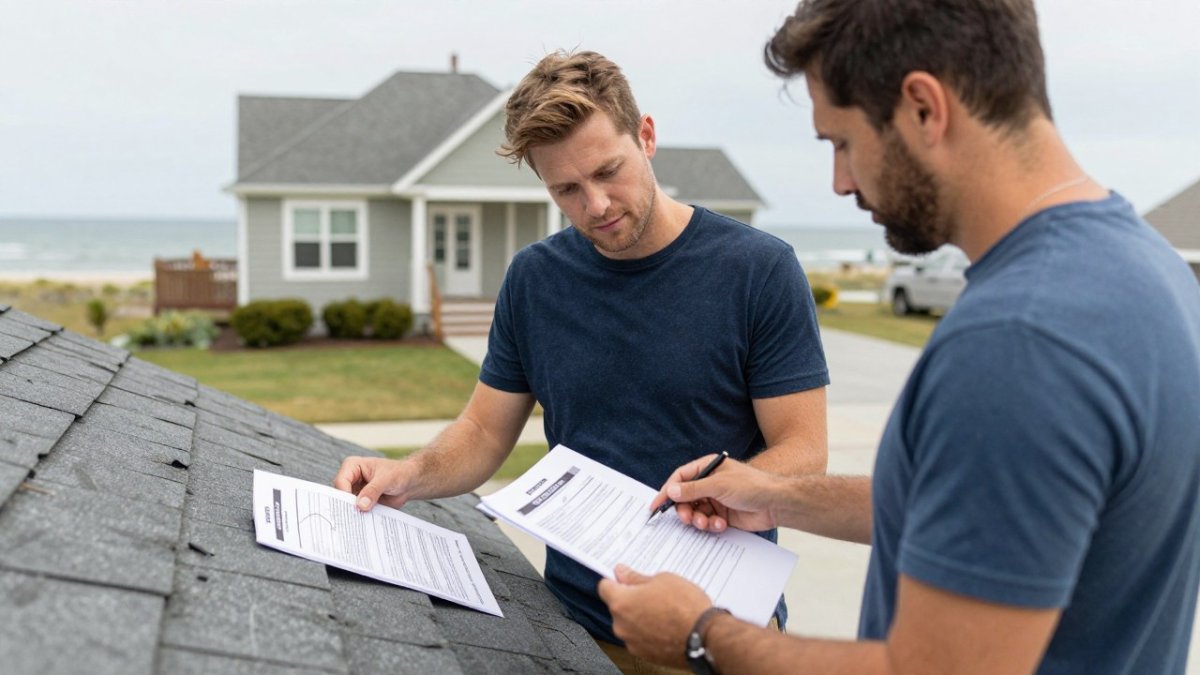
- Proof of property ownership, such as a deed or official record
- Mortgage documentation, if applicable
- Homeowners insurance policy and declarations page
- Recent property tax receipt
- Past roof repair or installation invoices and warranties
- Photos of the roof, taken from ground level, showing its general condition
- Contractor bids or estimates, if you are planning work
Note: Requirements can change, so confirm the current list with your evaluator before you submit anything.
How to Make a FORTIFIED Roof Certificate Request
The certificate request is the formal step that turns a passing evaluation into a document you can use. Most stalled requests are not caused by a failed roof; they stall on paperwork or on a mismatch between the request and the evaluation record. This section walks through the request in the order that prevents those problems.
-
Confirm the evaluation is complete and documented. Before you request anything, make sure the evaluator has finished the review and recorded a passing result. A request filed before the evaluation is closed will usually be held. Ask your evaluator to confirm in writing that the file is complete and that no open items remain.
-
Match the property information exactly. The request must match the property record: the legal owner’s name as it appears on the deed, the full street address, and the parcel or tax identifier if the program asks for it. A nickname, an abbreviated street name, or a name that differs from the deed is one of the most common causes of a returned request.
-
Gather supporting records. Use the documentation checklist in this guide, and add the repair invoices and any written notes from the evaluator about corrections. Scan each document at a readable resolution and keep the originals. Missing or unreadable attachments are a frequent reason requests are returned for resubmission.
-
Submit through the designated channel. Send the request only through the channel your evaluator or the program specifies. Keep a copy of the submitted package and the date you sent it. If the program issues a confirmation number or receipt, record it with the other home documents.
-
Track the status against a stated timeframe. Ask the evaluator or program for the expected processing window when you submit. If that window passes with no update, follow up with the confirmation number in hand rather than resubmitting, since a duplicate request can create a second file that delays both.
Watch out: Incomplete paperwork is the leading cause of a stalled request. Check every field against the deed and the evaluation record before you send, and do not send a request in which the owner name, address, or roof details differ from the evaluation file.
Watch out: If the request is returned, read the reason carefully before changing anything. A returned request is usually fixed by correcting one specific item and resubmitting that item, not by starting the entire package over.
Working With a FORTIFIED Certified Service Provider
Choosing the right contractor affects whether your roof passes. Look for a provider who understands FORTIFIED requirements and can explain them clearly.
Ask these questions:
- Do you have experience with FORTIFIED-standard work?
- Can you show me how my roof will be assessed?
- Can you provide written estimates?
Verify credentials before you sign anything. Ask for proof of the provider’s certifications and check them directly with the issuing program.
At Maven Roofing, we are GAF Master Elite certified and serve homeowners in Eastern North Carolina. We will tell you plainly what your roof needs.
Booking Your Free Roof Inspection to Start Your FORTIFIED Roof Review
If you are not sure where your roof stands, start with a free roof inspection. We will look at your roof, explain its condition, and tell you whether repairs or an evaluation make sense first. There is no pressure to buy anything.
book a free roof inspection to get started.
Maven Roofing has served Eastern North Carolina since 2015, and we want your roof to be ready. Book your free inspection today and take the first step toward a roof you can count on.
Frequently Asked Questions
Who can evaluate a roof for a FORTIFIED designation?
A FORTIFIED designation is verified by a qualified independent evaluator, not by the homeowner or the roofing company performing the work. Evaluators inspect the roof against FORTIFIED standards and confirm whether the installed components meet them. Before you schedule an evaluation, confirm the evaluator’s credentials and ask how the inspection will be documented. A free roof inspection from Maven Roofing can help you understand your roof’s current condition before you request an evaluation.
What documentation is needed for a FORTIFIED Roof certificate?
Evaluators typically look for records that show what was installed, when, and by whom. Useful documents include contractor invoices, product information for shingles or metal panels, installation records, and any prior inspection reports. Keep copies of your property records and your roof’s maintenance history in one folder so they are easy to share. Requirements can vary, so confirm with the evaluator which items they need before the inspection date.
Can an existing roof qualify for a FORTIFIED designation?
An existing roof may qualify if its components and condition meet the applicable FORTIFIED standards at the time of evaluation. Roofs with worn shingles, loose fasteners, or damaged flashing may need repairs before they can pass. A free roof inspection from Maven Roofing can identify these issues early so you know what to address before requesting an evaluation. We cannot guarantee a designation outcome, since the final decision rests with the independent evaluator.
