

Maven Resource Blog
How to Verify Roofing Certifications Before You Hire
Check roofing certifications, licenses and insurance before hiring. Learn the exact steps to confirm each credential's status, then book a free inspection.
Book a free roof inspection
Last Updated: October 30, 2026
Quick Summary
To verify roofing certifications, confirm the contractor’s license status with the issuing state or local authority, call the insurer to confirm general liability and workers’ compensation are active, and check manufacturer certifications on the manufacturer’s own website rather than the contractor’s. Match each credential’s scope to your roof type before signing.
- Ask for the exact legal business name and license number, not a nickname or DBA.
- Confirm the license status reads active or good standing and review disciplinary history.
- Call the agent on the certificate of insurance to confirm both policies are active.
- Verify manufacturer certifications using the manufacturer’s find-a-contractor tool, not the contractor’s badge.
- A missing record is not automatic fraud, but ask for it in writing and give one business day.
Table of Contents
- Why Verifying Roofing Certifications Protects Your Home
- Licenses, Certifications, and Roof Condition Reports: Know the Difference
- How to Verify a Roofing Contractor’s License Step by Step
- How to Check if a Roofer Is Insured
- Verifying Manufacturer Certifications Directly With the Issuing Organization
- Your Roofing Contractor Credentials Checklist
- Questions to Ask a Roofing Contractor About Credentials
- Red Flags and What to Do When a Credential Record Is Missing
- Frequently Asked Questions
Why Verifying Roofing Certifications Protects Your Home
Roofing certifications are third-party credentials that confirm a contractor has met a specific standard for training, installation skill, or business practices. Browse the Maven Roofing blog for more trusted roofing resources and inspections as you begin your research.
At Maven Roofing, we work in a coastal climate where wind, salt spray, and heavy rain punish every roof system.
Below, we’ll show you how to check licenses, certifications, and insurance in a repeatable order, and explain the difference between three credentials that get mixed up constantly.
Licenses, Certifications, and Roof Condition Reports: Know the Difference
Most homeowners treat these three terms as synonyms. They are not, and confusing them can cost you real money.
A contractor license is a legal permission to operate and perform work, issued by a state or local authority. A manufacturer or professional certification is a voluntary credential from a private organization that confirms training or installation knowledge. A roof condition certification is a report about the roof itself, not about the person who works on it.
| Credential | Who Issues It | What It Proves | Who It Protects |
|---|---|---|---|
| Contractor license | State or local licensing board | Legal right to work | You, legally |
| Manufacturer certification | Shingle or roofing manufacturer | Installation knowledge | Your warranty |
| Roof condition report | Inspector or roofing firm | Current roof condition | Buyers and realtors |
Contractor Licenses
A contractor license is the legal baseline. Without a valid one, a roofer should not be taking your money for structural work, and you should ask which authority licenses them. Licensing rules vary by jurisdiction, so check the authority that governs your address.
Manufacturer and Professional Certifications
Manufacturer certifications are voluntary, and they matter mainly for warranty terms. Many shingle warranties require installation by a certified contractor, who has completed the manufacturer’s training and understands the roof system as a whole, not just the shingles.
Professional certifications from trade organizations work the same way. They signal ongoing training, but they do not replace a license.
Roof Condition Certifications
A roof condition certification is a written report on the state of your roof, common during a home sale when buyers, realtors, and lenders want an independent look. It says nothing about whether the inspector’s company is licensed to install a new roof.
How to Verify a Roofing Contractor’s License Step by Step
Verifying a roofing contractor’s license takes about ten minutes and follows the same path in most states. Start with the name on the contract, not the name on the truck.
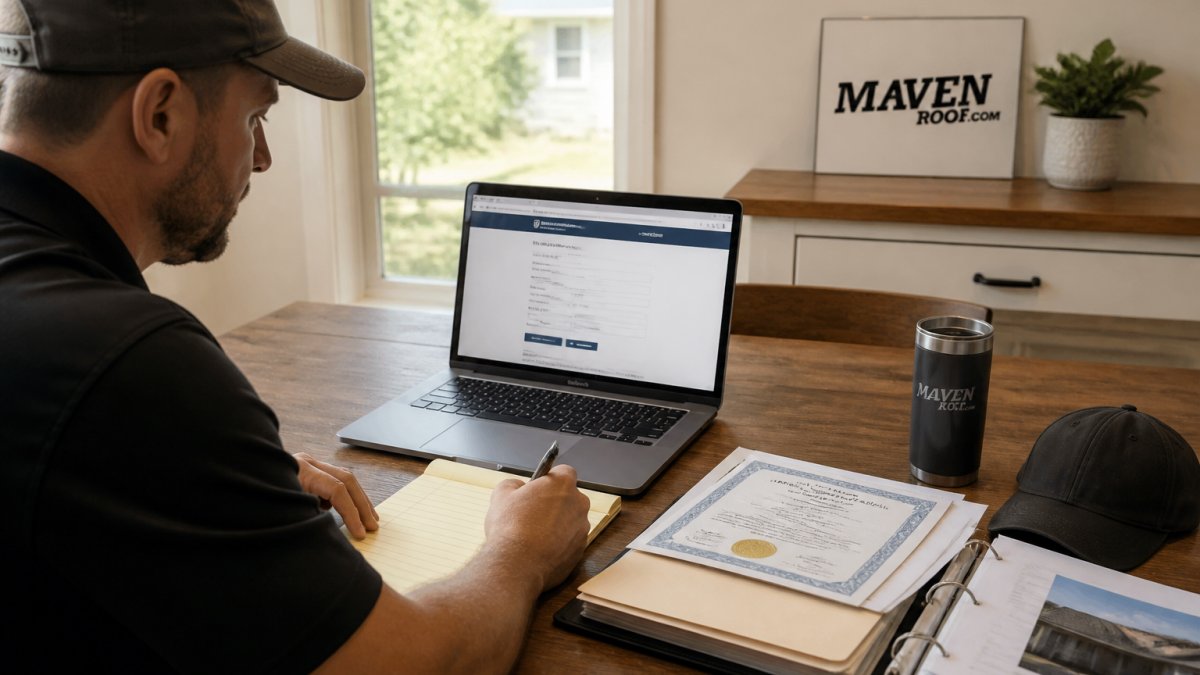
- Get the legal business name. Ask for the exact name on the license, plus the license number. You can also review Maven Roofing’s licensing credentials to confirm the company is properly licensed before hiring. A nickname or a DBA can hide a different entity.
- Find the licensing authority. Search your state’s contractor licensing board, or your county and city if they issue local permits.
- Search the official directory. Enter the license number first. If it does not return a result, try the company name and the representative name.
- Confirm the status is current. Look for “active,” “valid,” or “good standing.” An expired license is not a license.
- Check the classification. Make sure the license covers residential or commercial roofing, not just general work.
- Review disciplinary history. Most directories list complaints and actions. Read them rather than skimming the status field.
- Save a screenshot. Date-stamp the record so you have proof of what you checked.
What to Do Where Roofing Licenses Are Not Issued Statewide
This is the part most guides skip. Not every state issues a statewide roofing license. In some states, roofing is regulated at the county or municipal level through building permits and local business licensing, and in a few there is no separate roofing license at all, general contractor rules or registration requirements apply instead.
That means the correct first question is not “What is the state license number?” but “Which authority actually regulates roofing at my address?”
- Start with your state’s contractor licensing board. Even where roofing is not licensed statewide, the board’s website usually explains what is required and points to local authorities.
- Check your county or city building department. Ask whether a roofing permit requires a licensed or registered contractor and which credential they accept.
- Check the permit record itself. In many jurisdictions, permits are public. A permit pulled under the contractor’s legal name is a strong signal the company is operating the way the local authority expects.
If two authorities seem to apply, say, a state registration plus a county permit requirement, verify both. It is common for a contractor to hold one and quietly lack the other.
Reading the Directory Record Correctly
A license lookup returns more than a yes-or-no answer. Read the whole record:
- Entity type. The name on your contract should match the licensed entity, not a trade name.
- Qualifying party. In many states, a license is tied to a named individual who passed the exam. If that person has left the company, the license status can change.
- Expiration date. Confirm the date covers your project window, not just today.
When the Record Cannot Be Found
A missing record is not automatically fraud, but it always needs an answer before you proceed.
Ask the contractor to produce the record in writing, the license number, the issuing authority, and the current status. Give them a business day.
Your state’s contractor licensing board is the most direct place to start, and many state boards publish their own lookup tools.
How to Check if a Roofer Is Insured
Insurance verification is the step homeowners skip most often, and it is the one that matters after an accident. Ask for two separate documents: general liability insurance and workers’ compensation.
General liability covers damage to your property, a dropped bundle through a deck, a ladder through a window, a fire during torch work on a flat roof. Workers’ compensation covers injuries to crew members on your roof.
What a Certificate of Insurance Should Show
A certificate of insurance (COI) is a one-page summary the contractor’s agent issues. Read it line by line, not just the logo at the top:
Book Your Roof Inspection Online →
- Named insured. This should match the contractor’s legal business name, the same name on your contract and on the license record.
- Policy types. Look for commercial general liability and workers’ compensation as separate lines. A single line labeled “insurance” is not enough.
- Policy numbers and effective dates. Confirm the policy is active today and that the expiration date falls after your project is scheduled to finish.
A certificate of insurance is not proof of coverage on its own. It is a snapshot, and policies get cancelled. A quick call to the agent closes that gap.
Confirming Coverage With the Insurer
Certificates can be altered, and screenshots are even easier to fake. The fix is a phone call to the agent listed on the COI, not to the contractor’s office, and not to a number the contractor texts you.
Ask the agent to confirm four things:
- The policy is active as of today.
- The named insured matches the contractor’s legal name.
- The coverage types include general liability and workers’ compensation.
- The policy dates cover your project window.
Write down the date, the agent’s name, and what they confirmed. That note is your record if a dispute arises later.
Subcontractors and Additional Crews
Ask whether the crew on your roof will be employees or subcontractors. If subcontractors are used, ask for their certificates too. A contractor’s own policy does not automatically cover a subcontracted crew, and an uninsured sub on your roof is the same risk to you as an uninsured employee.
Insurance and Storm Claims
If your project involves storm, wind, hail, or leak damage, insurance documentation gets more involved. A contractor comfortable working with adjusters will document damage and coordinate with your insurer. When appropriate, we document storm damage and work with insurance adjusters, and we are glad to walk through what that looks like during a free roof inspection.
The two-minute version: get the COI, read the named insured and dates, call the agent on the certificate, and confirm both general liability and workers’ compensation are active. If any of those steps stalls, pause the project.
Verifying Manufacturer Certifications Directly With the Issuing Organization
Manufacturer certifications are the easiest credentials to fake, because there is no government database behind them. The fix is simple: verify with the manufacturer, not the contractor.
Many shingle manufacturers publish a find-a-contractor tool on their own website. Search the company name there.
For other professional certifications, contact the issuing organization directly. Ask three questions:
- Is this company currently in good standing?
- What is the certification scope, and does it cover my roof type?
- When does it renew, and has it ever lapsed?
Certification scope matters more than the badge. A credential for steep-slope shingle work does not automatically cover flat roofing systems or standing-seam metal.
Your Roofing Contractor Credentials Checklist
Use this list before you sign anything. Print it, or keep it open on your phone during the meeting.
- Legal business name and license number written on the contract
- License status confirmed as active and in good standing
- License classification covers the work you need
A contractor who hesitates on any line above is telling you something. Paperwork should be boring and fast to produce.
Questions to Ask a Roofing Contractor About Credentials
Ask these in the first meeting, before pricing comes up. For the full hiring process around these checks, read How to Choose a Roofing Contractor: Step-by-Step. The answers tell you more than any brochure.
- What is your license number, and which board issued it?
- Can you send your certificate of insurance with my address listed?
- Which manufacturer certifications do you hold, and at what tier?
That last question separates talkers from operators. A contractor with real local history will have names ready.
Red Flags and What to Do When a Credential Record Is Missing
Here are the warning signs that should end the conversation:
- The license number cannot be found in any official directory
- The name on the license does not match the contract
- Insurance documents arrive only as screenshots or photos
If a record is missing, ask the contractor to produce it in writing. Our guide to vetting local contractors covers what to do when a credential check raises doubts. Give them a day. A legitimate business will clear it up quickly.
Hiring a roofer should not feel like an interrogation. It should feel like a short, boring paperwork check that ends with confidence.
Frequently Asked Questions
What is the difference between a roofing license and a roofing certification?
A contractor license is a legal authorization issued by a state or local licensing authority that lets a company perform roofing work, and it can be checked through an official directory or license lookup. A roofing certification is a credential from a manufacturer or trade organization confirming training on a specific roof system. A license proves the company may legally operate; a certification shows installation knowledge for particular products. Verify both, and remember that a roof condition certification is a separate report on the roof itself, not a credential held by the contractor.
How can I check whether a roofing certification is current?
Ask the contractor for the credential holder’s name and the issuing organization, then contact that organization directly to confirm the certification is valid and not expired. Manufacturer certification directories and trade association records let you search by company name or representative name. Confirm the scope of the certification too, since some cover residential roofing only while others extend to commercial roofing. A current credential should be easy for a legitimate contractor to document on request.
How do I find out if a roofer is insured?
Request a certificate of insurance showing both general liability insurance and workers’ compensation coverage, then call the insurer listed on the certificate to confirm the policy is active and the coverage limits. Ask whether the policy covers residential roofing and commercial roofing if your project needs it. Do not rely on a verbal assurance or a photocopy alone. If a contractor cannot produce a current certificate, treat that as a serious red flag and keep looking.
What should I ask a roofing contractor about their certifications?
Ask which certifications the company and its installers hold, who issued them, when they expire, and whether the crew assigned to your roof is certified on the specific roof system being installed. Request the license number and the name of the licensing authority so you can run a license lookup yourself. Ask for proof of insurance and a few local references. A contractor who answers these questions promptly and in writing is showing you the credential verification habits you want before you hire.
