

Maven Resource Blog
How Can You Tell If a Roof Leak Is Hidden?
Learn the signs of hidden water intrusion in ceilings, drywall and roofs, plus safe checks homeowners can do before calling a roofer for a free inspection.
Book a free roof inspection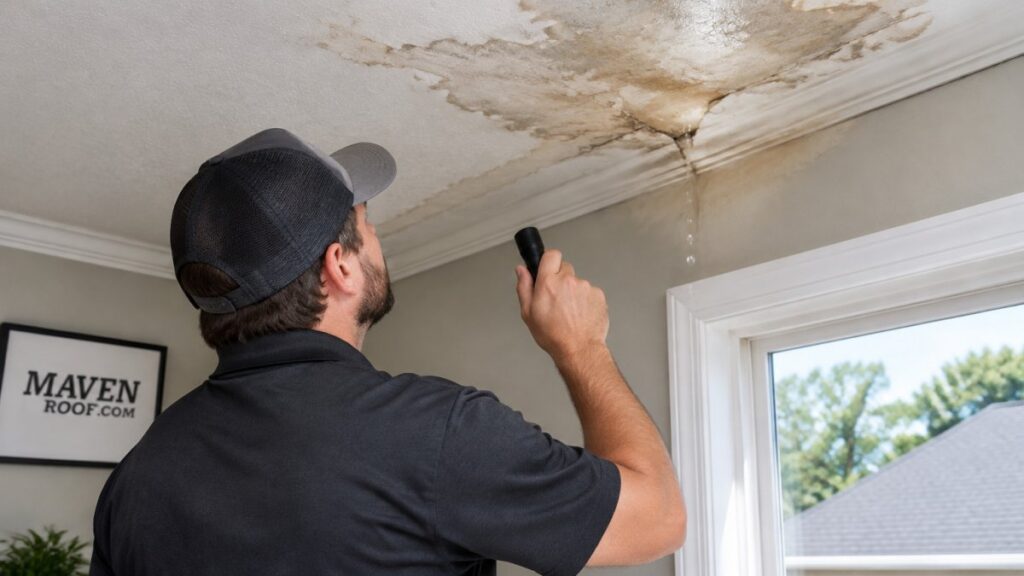
Last Updated: November 16, 2026
Quick Summary
Hidden water intrusion often shows up first as stains, soft drywall, peeling paint or a musty smell on the ceilings and walls below the roof. Water can soak insulation and framing for weeks before a stain appears, so a dry ceiling does not guarantee a dry roof. Check the ceiling after rain and look for changes that grow over time.
- Check ceiling corners and areas around recessed lights and vent fans first.
- Press gently on drywall; spongy or crumbly areas suggest water has soaked it.
- Turn off all fixtures and read the water meter to rule out plumbing before blaming the roof.
- Trace stains in pencil, date them and photograph them to see if they grow after rain.
- Do not walk on a wet or steep roof; have a professional inspect it safely.
Table of Contents
- Why Hidden Water Intrusion Is So Easy to Miss
- Warning Signs on Ceilings and Drywall
- Signs of Hidden Water Intrusion in Drywall Near the Roofline
- A Low-Risk Homeowner Check: How to Find a Roof Leak Safely
- Telling a Roof Leak Apart From Plumbing, Window or Condensation Problems
- Roof Leak Inspection: What a Professional Assessment Involves
- Book Your Free Roof Inspection With Maven Roofing
- Frequently Asked Questions
Why Hidden Water Intrusion Is So Easy to Miss
Hidden water intrusion is the slow entry of water into a roof assembly, wall or ceiling where you cannot see it at first.
Water finds the easiest path. It can travel along a rafter, down a wall cavity or across a ceiling joist before it shows up as a spot.
Coastal conditions make this worse. Humid air, heavy rain and wind-driven storms push water into places a calm day never would.
Watch out: A dry ceiling does not mean a dry roof. Water can soak insulation and framing long before it reaches the drywall.
Warning Signs on Ceilings and Drywall
Most hidden leaks show up first on the ceiling or walls below the roof. These signs are easy to check from inside the house, and you do not need tools to start.
Stains, Soft Spots and Peeling Paint
Water stains are often the first clue. Look for yellow, brown or gray rings, especially near corners, light fixtures, and where walls meet the ceiling. A stain that grows after rain is a strong sign of an active leak.
Soft spots matter too. Press gently on the drywall. If it feels spongy, crumbly or bends under light pressure, water has likely soaked it. Peeling or bubbling paint works the same way. Moisture pushes the paint off the surface from behind.
Check these spots first:
- Ceiling corners and areas around recessed lights or vent fans
- Top edges of walls, especially along exterior walls
- Trim, baseboards and window frames that look warped or dark
- Light switch covers that show dampness
Musty Odors and Visible Mildew
A musty smell in an upstairs room or attic is worth checking. Mold and mildew often grow in damp insulation and drywall before anyone sees a stain. The smell can be the first sign.
Look for dark, fuzzy or speckled growth on drywall, ceiling joists or insulation. Mildew can look like light gray or black spots.
Most hidden leaks show up first on the ceiling or walls below the roof, and these signs are easy to check from inside the house.
| Sign | Where to look | What it suggests |
|---|---|---|
| Water stain | Ceiling corners, fixtures, wall tops | Possible active leak, especially if it grows after rain |
| Soft or spongy drywall | Pressed gently on ceilings and walls | Water has likely soaked the drywall |
| Peeling or bubbling paint | Ceilings and upper walls | Moisture pushing paint off from behind |
| Musty odor | Upstairs rooms and attic | Mold or mildew in damp insulation or drywall |
| Dark fuzzy or speckled growth | Drywall, joists, insulation | Mold or mildew; get a professional if widespread |
Signs of Hidden Water Intrusion in Drywall Near the Roofline
Drywall near the roofline is where hidden leaks often first show. Check the top of exterior walls and the ceiling edge along the outside walls.
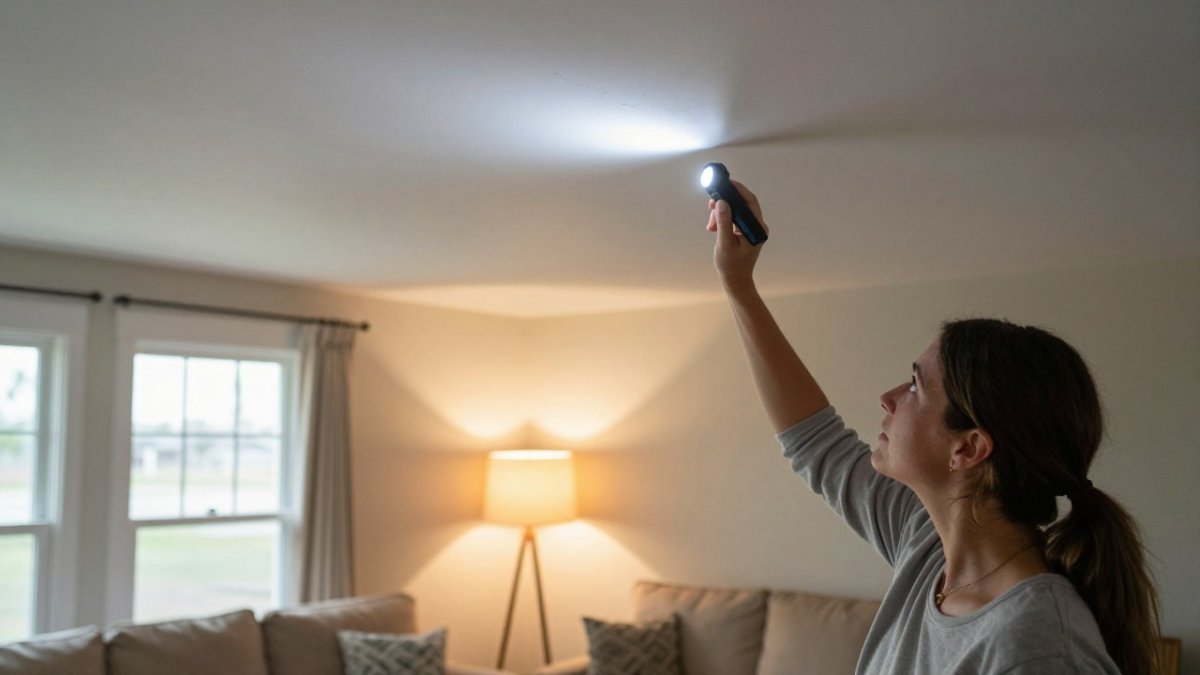
A homeowner might spot a faint water stain in a ceiling corner after a storm.
Pay attention to changes over time. A stain that is slowly getting larger, or drywall that softens after each rain, points to an ongoing leak.
A Low-Risk Homeowner Check: How to Find a Roof Leak Safely
You can narrow down a suspected roof leak from inside the house and from the ground, without opening walls or climbing on a wet roof. The goal is not to fix anything, it is to gather enough evidence to know whether you are dealing with an active leak and where it is likely entering. Do not walk on a wet or steep roof. Falls are a serious risk, and a professional can inspect the roof safely.
Step 1: Rule Out Plumbing First
Before you blame the roof, spend a few minutes on the water meter. Turn off every fixture in the house, faucets, the washing machine, the dishwasher, ice maker, and outdoor spigots. Then look at the meter. If the leak dial or the low-flow indicator is still moving, water is running somewhere in the plumbing system. Note the reading, wait 30 to 60 minutes without using any water, and read it again.
If the meter holds steady, the odds shift toward roof, flashing, or condensation. That single check saves a lot of guesswork.
Step 2: Check the Ceilings After Rain
Look at the top-floor ceilings and the upper walls within an hour or two of a storm, while the evidence is fresh. Use a flashlight held at a low angle across the surface, raking light reveals faint rings, shadows, and slight bulges that disappear under normal overhead light. Pay closest attention to ceiling corners, the ceiling edge along exterior walls, and the area around recessed lights and vent fans.
Step 3: Read the Attic Carefully
In the attic, look at the underside of the roof boards and the top of the insulation. Dark staining on the sheathing, insulation that looks matted or darker than its neighbors, and daylight showing through the roof deck are all worth noting. Rusty nail tips on the sheathing are another common clue that moisture has been present.
Watch out: Do not touch wet insulation or wiring, and do not step off the joists, stay on the framing and keep a flashlight on the path ahead of you.
Step 4: Look at the Exterior From the Ground
From a safe spot on the ground, scan the roof for lifted, cracked, or missing shingles, flashing that has pulled away from a chimney or wall, and gutters that are sagging or full. Binoculars help. Note anything that looks different from the last time you looked.
Step 5: Document What You Find
Trace the outline of any stain in pencil and write the date next to it. Photograph the stain, the attic sheathing, and the exterior area above it. Then check again after the next rain and compare.
Keep a flashlight, a pencil, a phone camera, and a notebook handy. You do not need special tools for this check, and you should not open walls or probe near electrical fixtures to chase a leak.
Reading Moisture and Humidity Clues
A basic moisture meter, available at most hardware stores, can tell you whether drywall or wood is damp even when it looks dry to the eye. Readings are relative, what matters is the difference between a suspect area and a known-dry area nearby. A pin-type meter leaves small marks, so test in an inconspicuous spot. A home humidity gauge is also useful: persistently high indoor humidity in one room, especially after rain, can point to hidden moisture.
Telling a Roof Leak Apart From Plumbing, Window or Condensation Problems
Water stains do not always mean a roof leak. Plumbing, windows and condensation can cause similar marks, so it helps to compare where the water appears.
- Roof leaks usually show up on the top floor, near the roofline, and often after heavy rain or wind.
- Plumbing leaks tend to appear under sinks, behind toilets or near water lines, and they may stay damp even on dry days.
- Window leaks show up around the frame or sill, often after wind-driven rain from one direction.
- Condensation forms on cold surfaces, usually in cool weather, and tends to appear as beads on windows or dampness on exterior walls.
If the stain sits directly below the roof and appears after a storm, the roof is the likely source. If the stain is under a bathroom or kitchen, check plumbing first. A professional can confirm the source with a closer look.
Roof Leak Inspection: What a Professional Assessment Involves
A professional roof leak inspection can look at the roof and the spaces below it together. The goal is to find the entry point, not just the stain, water often enters at one spot and shows up somewhere else entirely.
What a Technician Typically Checks
- Roof surface: shingles, flashing at chimneys and walls, valleys, vents, and pipe boots for cracks, lifting, or missing material
- Attic: sheathing staining, wet or matted insulation, rusty fasteners, and any visible mold growth
- Roof edges and drainage: gutters, downspouts, and drip edges that may be pushing water back under the roof edge
- Interior: ceilings, upper walls, and trim for damp areas, soft drywall, and staining
- Penetrations: skylights, vents, and anything that interrupts the roof plane, since these are common entry points
Non-Invasive Detection Methods
Leak detection often does not require tearing into walls. Common methods include:
- Moisture meters to compare suspect areas against known-dry reference points
Each method has limits. Thermal imaging can be thrown off by sun exposure or insulation gaps, and a moisture meter tells you something is wet without telling you why.
What to Prepare Before the Visit
A little preparation makes the inspection faster and more useful:
- Note the dates and times you first saw each stain or damp area
- Photograph anything that has changed, including growth after rain
- Write down whether the problem appears after wind-driven rain from a particular direction
- Have your insurance policy information on hand if storm damage may be involved
- Clear safe access to the attic and any interior areas you want checked
After the Inspection
You should leave with a clear picture of what was found, where the likely entry point is, and what your options are, repair, maintenance, or a larger plan. If storm damage is involved, that documentation can support an insurance claim, and we can coordinate with your adjuster when appropriate.
Book Your Free Roof Inspection With Maven Roofing
If you see stains, soft drywall, peeling paint or musty odors, do not wait for the next storm to find out how far the water has gone. Hidden leaks get more expensive the longer they run. Maven Roofing offers free roof inspections across Eastern North Carolina, with no-pressure recommendations.
Book your free roof inspection today, and let our veteran-owned team help you protect your home. NO QUIT on your roof starts with one honest look.
Frequently Asked Questions
What are the early warning signs of water intrusion?
The earliest signs are often subtle: a faint stain on a ceiling corner, paint that bubbles or peels, a musty smell that returns after cleaning, or a small uptick in your water bill with no obvious cause. Damp or soft drywall and baseboards are later signs. Catching these early usually means a smaller repair. If you notice more than one of these, schedule a free roof inspection so a professional can look at the roof, attic and flashing before the damage spreads.
How do roofing professionals find the source of a hidden leak?
A roofer typically starts in the attic, looking for wet decking, stained insulation, and rusted nails, then checks flashing, penetrations, valleys and damaged shingles. Moisture meters help trace areas that are still damp. Because water can travel along rafters before it appears indoors, the spot where water shows up is often not the spot where it entered. A thorough inspection follows the water path back to its source.
Will insurance cover hidden water damage?
Coverage depends on your policy and the cause of the damage, so we cannot promise an outcome. Sudden storm damage is often treated differently from long-term seepage. Documenting what you see with dated photos, keeping repair records, and noting when you first noticed symptoms can help. Maven Roofing can document roof damage and coordinate with insurance adjusters when appropriate, but your insurer makes the coverage decision.
What should you do when you find signs of a roof leak?
Take photos of the stains or damage before touching anything, place a bucket under active drips, and move valuables away from the area. If you can safely access the attic, look for wet insulation or daylight coming through the roof deck. Avoid walking on a wet roof or standing under ceilings that are sagging. Then book a free roof inspection so the source can be identified and repaired properly.
