

Maven Resource Blog
Edwards Roofing vs Patriot Roofing: 2026 Comparison
Edwards Roofing vs Patriot Roofing compared for 2026: services, estimates, warranties, and how to vet each contractor before you sign.
Book a free roof inspection
Table of Contents
- Edwards Roofing vs Patriot Roofing: What Homeowners Should Know First
- Edwards Roofing vs Patriot Roofing at a Glance
- Company Identity and Verified Service Areas
- Services: Roof Repair, Replacement, and Storm Damage
- Written Estimates, Total Project Costs, and Warranty Terms
- Questions to Ask a Roofing Contractor Before You Sign
- Your Roofing Contractor Checklist: Vetting Credentials and Reviews
- Roof Lifespan After Hail Damage: What to Expect
- Frequently Asked Questions
Last Updated: October 9, 2026
Edwards Roofing vs Patriot Roofing: What Homeowners Should Know First
Edwards Roofing vs Patriot Roofing is a comparison homeowners search for when two familiar names appear in the same local results, and the answer is less about which company is “better” and more about which one actually serves your address.
That mismatch is the single biggest thing most comparison pages get wrong. They line up two companies side by side as if both will show up in your driveway tomorrow.
Below, we break down what each name actually represents, what to verify before you sign anything, and how to run the comparison yourself.
Edwards Roofing vs Patriot Roofing at a Glance
The two names are not competing for the same customers, and that is the first thing to establish before any side-by-side makes sense. Edwards Roofing & Exteriors presents itself as a St. Louis-area contractor offering residential and commercial roofing with free estimates.
Because no single company operates under both names in the same market, a true head-to-head comparison only becomes meaningful once you confirm which entity is actually bidding on your roof.
| Comparison Point | Edwards Roofing & Exteriors | Patriot Roofing & Exteriors | Patriot Roofing (Chicago) |
|---|---|---|---|
| Reported service area | St. Louis area and beyond | Wilmington area | Chicago area |
| Listed services | Residential and commercial roofing | Not specified in available results | Emergency repairs, repairs, replacements |
| Pricing information | Free estimates; project-based | Contact for pricing | Not stated |
| Licensing and insurance | Verify with the state licensing board | Verify with the state licensing board | Verify with the state licensing board |
| Warranty terms | Request in writing | Request in writing | Request in writing |
| Storm and hail documentation | Ask whether they photograph and document for claims | Ask whether they photograph and document for claims | Ask whether they photograph and document for claims |
Three columns, three different states, and not one of them is a substitute for the other.
Two different companies use the Patriot Roofing name in two different states. Confirm the exact legal business name and address on the estimate before you pay a deposit, because a warranty from one Patriot does not transfer to the other.
When you fill in this table yourself, treat every blank as a question to ask, not a detail to assume. The cells a contractor will not fill in are usually the cells that matter most.
Company Identity and Verified Service Areas
Verified identity matters more than brand recognition in roofing. A company name on a truck proves nothing on its own; what matters is the legal entity, the physical address, and whether that entity is licensed and insured to work where you live.
That gap is exactly why we tell homeowners to start with the address, not the logo. A contractor working two states away cannot reasonably return for a callback on a leak, and storm damage rarely waits for a crew to drive in from out of state.
Here is how to verify identity in about fifteen minutes, in the order that matters:
- Pull the legal business name. Ask for it in writing, then search your state’s Secretary of State business registry to confirm the entity is active and in good standing. A trade name and a legal name are often different, and the legal name is the one that shows up in a dispute.
- Confirm the physical address. A registered agent address is not a place of business. Ask for the address where crews and equipment are staged, and check it against a mapping tool to confirm it is a real commercial location.
- Check the license. Most states maintain a public contractor licensing database. Search the legal business name and the license number, and confirm the license is current, matches the classification for roofing work, and lists the correct qualifying individual.
- Read the certificate of insurance. Ask for a certificate naming general liability and workers’ compensation coverage, then call the insurer listed on the certificate to confirm the policy is active. A certificate alone can be outdated or altered.
- Confirm the service radius. Ask how far the company travels for warranty callbacks, not just for new installs. The answer to the callback question is the one that tells you whether they will actually come back.
For coastal properties, the local factor compounds. Salt spray, humidity, and hurricane-season wind-driven rain put different demands on a roof than inland weather does. A contractor who works that coastline regularly knows how those conditions age shingles, flashing, and ventilation.
Ask each contractor for three local references from jobs completed at least two years ago, not last month. A roof that has been through two storm seasons tells you more about workmanship than a roof installed three weeks ago.
The point of all this verification is not to disqualify anyone. It is to make sure the company you are comparing is the company that will actually show up, and that the warranty you are counting on belongs to an entity that will still exist when you need it.
Services: Roof Repair, Replacement, and Storm Damage
Roof repair, roof replacement, and storm damage response are the three services homeowners actually shop for, and each company’s public listings describe them differently. Edwards Roofing & Exteriors lists both residential and commercial roofing. Patriot Roofing in Chicago lists emergency response, repairs, and complete replacements for homes and businesses. The Wilmington Patriot Roofing listing does not spell out its service menu in the results available to us.
Here is how we would sort the decision:
- Roof repair suits isolated damage: a few lifted shingles, a failed pipe boot, a small leak traced to one flashing detail.
- Roof replacement fits widespread granule loss, multiple leak points, or an aging roof that keeps failing inspections.
- Storm and hail damage needs a contractor who documents the damage properly, photographs it, and can walk an adjuster through what happened.
- Roof rejuvenation is worth asking about when the shingles are structurally sound but stained with moss, algae, or dirt from coastal humidity.
That last category is where a lot of homeowners get surprised. Not every roof needs to come off.
Book Your Free Roof Inspection Online →
Written Estimates, Total Project Costs, and Warranty Terms
A written estimate is the only estimate that counts. Verbal numbers change. A written estimate should itemize materials, labor, tear-off and disposal, permits, and any decking repair allowance, so you can compare two bids line by line instead of comparing two totals. None of the companies reviewed here publish project pricing; all of them direct homeowners to request a quote. That is normal for roofing, and it is not a red flag on its own.
What is a red flag is a bid that leaves out the boring parts. Ask specifically about:
- Tear-off and dumpster fees
- Permit costs and who pulls the permit
- Decking replacement, priced per sheet
- Flashing, ridge vent, and drip edge
- Whether the workmanship warranty is written and transferable
- Whether the manufacturer warranty registration is handled for you
Ask for the workmanship warranty in writing before you sign, and ask what voids it. On many roofs, the warranty is voided by a second contractor doing repairs later, which matters if you ever sell the house.
Questions to Ask a Roofing Contractor Before You Sign
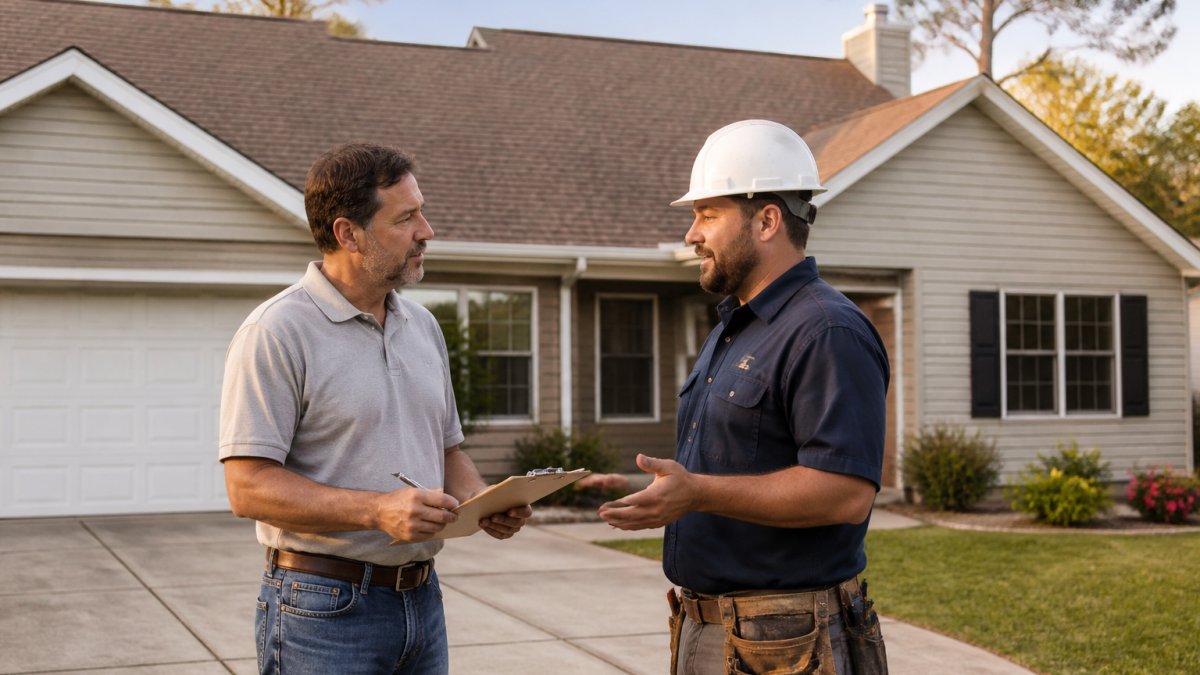
Ask these questions before signing anything, and write down the answers. The right questions separate a contractor who will still answer the phone in year three from one who will not.
- What is your legal business name and physical address?
- Are you licensed and insured for work in this state, and can I see the certificate?
- Will you provide a written, itemized estimate before any work begins?
- Who pulls the permit, and is it included in the price?
- What does your workmanship warranty cover, and how long does it last?
- Will you document storm damage for my insurance claim?
- Who is my point of contact if something goes wrong after the job?
- What is the project timeline, and what happens if weather delays it?
- Will you do a final walkthrough and magnetic sweep for nails before leaving?
Question nine is not a formality. Cleanup and a nail sweep are the difference between a finished job and a punctured tire.
Your Roofing Contractor Checklist: Vetting Credentials and Reviews
A roofing contractor checklist keeps you from comparing companies on personality instead of proof. Use this one, and check every box before you commit.
- Legal business name and physical address confirmed
- State licensing verified through the official state database
- Certificate of insurance for general liability and workers’ compensation on file
- Written, itemized estimate received
- Workmanship warranty terms in writing
- Manufacturer warranty details and registration process confirmed
- At least three recent local references contacted
- Customer reviews read across more than one platform, not just the company site
- Timeline and payment schedule in writing
- Cleanup and final inspection terms agreed
Two items on that list deserve extra weight. Licensing is verifiable through your state’s official contractor licensing board, and you should check it yourself rather than accepting a number on a business card. Reviews deserve the same skepticism: read the negative ones first, and pay attention to how the company responded.
The estimate, the insurance certificate, and the warranty are the three documents that decide whether you are protected. If a contractor hesitates on any of the three, that hesitation is your answer.
Roof Lifespan After Hail Damage: What to Expect
Hail damage shortens roof lifespan, but the size of the hit depends on shingle type, hail size, and how many impacts landed on the same slope.
Three factors drive the outcome:
- Hail size and density. Larger stones at higher speeds cause deeper mat damage.
- Shingle material. Asphalt shingles bruise and lose granules; metal roofing dents and can sometimes be repaired.
- Age at impact. An older roof with already-thin granules has less margin to absorb damage.
Get an inspection after any significant hail event, even if you see nothing from the ground. Bruising is often invisible from a ladder and shows up clearly on a close inspection of the slopes.
Hail season and hurricane season both test a roof’s weakest details, and the difference between a repair and a full replacement usually comes down to what an inspection finds.
Frequently Asked Questions
What should I compare when choosing between Edwards Roofing and Patriot Roofing?
Compare written estimates line by line, including materials, labor, disposal, and timeline. Verify each company’s license, insurance, and physical address, and check recent customer reviews for workmanship and communication. Ask about warranty terms in writing and how each handles insurance claims for storm or hail damage.
How long will a roof last after hail damage?
It depends on shingle type and hail size. Asphalt shingles hit by large hail can lose years of service life even when damage looks minor, while metal roofing often withstands hail with cosmetic dents only. After a storm, a professional roof inspection can document granule loss, bruising, or cracked shingles and estimate remaining lifespan. In coastal areas, salt spray and humidity can accelerate wear, so annual inspections help you catch problems early.
How can I tell if a roofer is being dishonest?
Watch for pressure to sign the same day, demands for full payment upfront, no physical address or license number, and vague written estimates that omit materials or disposal. A legitimate contractor provides a written estimate, proof of insurance, and references you can call. If a roofer offers to waive your insurance deductible, that is a red flag. Always get at least two written quotes and verify credentials with your state licensing board.
What is the 25% rule in roofing?
The 25% rule generally refers to insurance claim thresholds: if storm damage affects more than roughly a quarter of your roof’s surface, many insurers pay for a full replacement rather than a partial repair. The exact threshold varies by policy and state. Document damage with photos and a professional inspection report, and ask your adjuster how the rule applies to your claim before authorizing any work.
How do I verify a roofing contractor’s credentials and references?
Ask for the license number, general liability and workers’ compensation insurance certificates, and a physical business address. Cross-check the license with your state’s contractor licensing board, confirm the business on Google Maps listings, and read recent customer reviews. Then call two or three past clients and ask whether the crew showed up on schedule, cleaned up, and honored warranty work. A written roofing contractor checklist keeps this process consistent across every bid you collect.